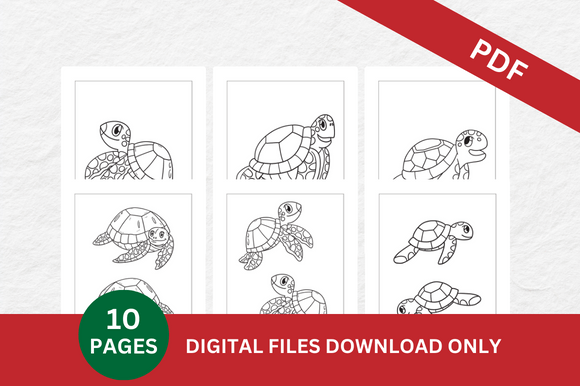
Turtle Coloring Pages for Creative Projects
There is something naturally compelling about turtles. Their slow, deliberate pace, the intricate geometry of their shells, and their quiet resilience make them a subject that appeals to both children and adults. Turtle coloring pages tap into this appeal, offering not just a simple pastime but a versatile creative resource. Whether you are a designer looking for fresh content, an educator preparing classroom materials, or a self-publisher building a KDP product, these pages provide a structured yet flexible foundation for a wide range of projects.
The specific set described here — a 10-page collection sized at 8.5″ x 11″ inches, with no bleed and a print-ready PDF format — is designed with practical production in mind. This format works seamlessly for Amazon KDP, making it straightforward to upload, test, and publish. But beyond the technical specifications, what really matters is how you can use these turtle coloring pages to create something meaningful for your audience.
What Makes Turtle Coloring Pages a Useful Creative Resource
Turtles offer a rare combination of organic and geometric elements. The shell, with its repeating hexagonal or scute patterns, gives you a natural framework for intricate line work, mandala-style fills, and detailed shading. The body, meanwhile, allows for softer, more organic shapes — the curve of a flipper, the gentle line of a neck, the expression in an eye. This balance between structure and fluidity makes turtle designs particularly satisfying to color, and equally satisfying to design or adapt.
For creators, this means you have a subject that works across multiple styles. You can produce realistic illustrations with careful anatomical detail, or stylized, whimsical designs with oversized eyes and playful patterns. The same basic page layout can be reinterpreted for different age groups, skill levels, or aesthetic preferences. This flexibility is valuable when you are trying to build a product line that appeals to a broad audience without starting from scratch each time.
From a symbolic standpoint, turtles carry meanings that resonate across cultures — patience, longevity, protection, and groundedness. These themes add an emotional layer to the activity, making turtle coloring pages suitable for relaxation, mindfulness, or educational contexts. People color not just for fun, but for calm, and a subject with positive associations can enhance that experience.
Creative Applications Across Different Audiences and Platforms
One of the strongest advantages of turtle coloring pages is their adaptability. The same 10-page PDF can serve very different purposes depending on how you frame and present it.
For self-publishers and KDP entrepreneurs
If you are building a low-content or medium-content book business, the specifications here are ideal. The 8.5″ x 11″ trim size is standard for coloring books, and the no-bleed setup means you can upload the PDF directly without worrying about margin adjustments. Your audience might include parents looking for screen-free activities, adults seeking stress relief, or teachers needing themed worksheets. A turtle coloring book can be positioned as a general interest title, or you can niche it further — ocean life collection, mindfulness through nature, or even a learning tool for kids who love animals. The key is to use the pages as a consistent base and then market the book toward a specific need.
For educators and homeschooling parents
Turtles naturally lend themselves to cross-curricular learning. A coloring page can be paired with a science lesson on reptile habitats, a geography discussion about sea turtles vs. land tortoises, or a reading activity about patience and slow living. The clean, print-ready PDF format means you can print individual pages as needed, without wasting ink on test prints. You can also ask students to label parts of the turtle, research a specific species, or write a short story inspired by the illustration. This turns a simple coloring activity into a multi-layered learning experience.
For designers and illustrators
Even if you are not publishing a coloring book yourself, turtle coloring pages can serve as inspiration or source material. The 10-page collection gives you a range of poses and layouts that you can study for composition ideas. How does the shell pattern guide the eye? How is negative space used around the turtle? You might trace or redraw elements to develop your own style, or use the pages as a base for digital coloring experiments in Procreate or Photoshop. The print-ready format also makes it easy to test your own color palettes before committing to a larger project.
For hobbyists and personal relaxation
Not every use case needs to be commercial. Many adults color simply for the joy of it, and a turtle theme offers a calming, meditative focus. The shell patterns allow for repetitive, soothing motions, while the animal itself carries a gentle presence. A dedicated set of turtle pages means you can rotate through different designs without searching for new images each time. The print-ready PDF can be printed on quality paper, stored in a folder, and revisited whenever you need a creative reset.
Practical Considerations for Keeping Results Clear and Effective
Regardless of how you plan to use turtle coloring pages, a few practical points will help you maintain quality and consistency.
- Check your print settings. The PDF is designed for 8.5″ x 11″ paper with no bleed. Make sure your printer or print service is set to actual size, not fit to page, to avoid unwanted scaling that can distort the lines or crop the edges.
- Test the line weight. Before printing a full batch, print one page to confirm that the lines are dark enough to color over but not so thick that they overwhelm the design. This is especially important if you plan to use markers or water-based pens that can bleed through thin lines.
- Consider paper choice. For coloring books, a heavier paper (60–80 lb) prevents bleed-through and gives a more premium feel. If you are printing for one-time use, standard copy paper works fine, but be aware that markers may ghost through to the other side.
- Organize your pages. The 10-page collection can be arranged in any order. You might sequence them by difficulty, starting with simpler designs and progressing to more detailed shell patterns. Alternatively, arrange them by theme — sea turtles on one side, land turtles on the other — to create a logical flow.
These details matter because they affect the user experience. A cleanly printed, well-organized coloring page feels professional and intentional, whether it is part of a paid product or a free resource. Taking a few extra minutes to verify format and paper quality can make the difference between a page that gets used once and one that gets returned to again and again.
Finding Inspiration While Staying Original
Working from a pre-made set of turtle coloring pages does not mean your final product has to be generic. There are many ways to add a personal or distinctive touch.
One approach is to treat the line art as a starting point and then build around it. You could add a background — coral reefs, pond vegetation, desert sand — to turn each page into a scene rather than just an isolated turtle. If you are working digitally, you can layer patterns, gradients, or textures behind the turtle to create a richer visual experience. For a coloring book, you might include a short prompt on the opposite page: “What pattern would you draw on this turtle’s shell?” or “Color the turtle using only warm tones.” These small additions transform a passive activity into a creative one.
Another strategy is to study the turtle designs for elements you can reuse in your own work. Notice how the shell segments are divided — can you adapt that hexagonal grid into a pattern for a notebook cover, a greeting card, or a fabric print? The eye shapes and head curves could inform a character design for a children’s book. The flipper positions suggest movement and could be referenced for an animation storyboard. By deconstructing the coloring pages, you train your eye to see possibilities beyond the immediate use case.
If you are publishing for KDP, consider bundling the turtle pages with related content. A companion activity sheet, a set of turtle-themed mazes, or a guide to drawing turtles can add value and differentiate your product from others. The 10-page core gives you a solid foundation, and the additions allow you to create something that feels complete and thoughtful.
Keeping the Experience Audience-Friendly
Finally, remember that the end user is looking for a positive, frustration-free experience. Whether that user is a busy parent printing pages for a rainy day, a teacher preparing a lesson, or an adult unwinding after work, they want clear lines, engaging designs, and a format that works without hassle.
Turtle coloring pages, when delivered as a print-ready PDF with consistent sizing and no unexpected technical issues, meet that need directly. The 10-page count is manageable — enough variety to hold interest, but not so many that it feels overwhelming. The subject matter is broadly appealing, and the creative potential is genuinely wide. As a creator, you can take this resource and shape it to fit your specific goals, knowing that the foundation is solid.
What makes this set interesting is not just the animals themselves, but the adaptability they offer. A single collection can serve as a relaxation tool, a teaching aid, a design reference, or a commercial product. The only limit is how you choose to apply it.