Light and Shadow Logic Puzzle: A Structured Approach to Deductive Reasoning and Brain Training
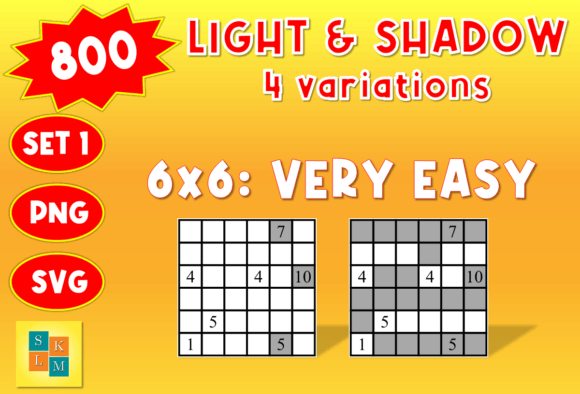
A Light and Shadow Logic Puzzle is a deductive reasoning game that challenges you to fill a grid based on numerical clues, determining which cells are "lit" and which remain in shadow. This specific listing delivers 800 puzzles across four grid sizes—6x6, 8x8, 10x10, and 12x12—with four difficulty levels ranging from very easy to hard. The format is designed for creators, publishers, and educators who need ready-to-use puzzle content that fits directly into production workflows.
What distinguishes this puzzle type from other logic puzzles is the binary decision process at its core. Each cell resolves to either light or shadow, and the clues around the grid tell you exactly how many lit cells appear in each row and column. This simplicity masks a deep logical structure. Solving requires systematic elimination, pattern recognition, and careful cross-referencing of constraints. For anyone who produces puzzle books, brain training materials, or educational resources, this set offers a complete package with both SVG and PNG files, solution sheets, and setup notes.
Understanding the Puzzle Structure and Its Practical Value
The Light and Shadow puzzle operates on a grid where every cell is either filled (shadow) or empty (light). Numerical clues along the top and left sides indicate the count of lit cells in each row and column. The solver must deduce the exact arrangement that satisfies all clues simultaneously. This is a classic constraint satisfaction problem, similar to those used in computer science and operations research, but presented in an accessible, human-friendly format.
The listing breaks down into four distinct variations:
- 6x6 grid – 200 puzzles (very easy) – Ideal for beginners, casual solvers, or warm-up exercises.
- 8x8 grid – 200 puzzles (easy) – A step up in complexity, suitable for regular practice.
- 10x10 grid – 200 puzzles (medium) – Demands more sustained attention and logical chaining.
- 12x12 grid – 200 puzzles (hard) – Challenges experienced solvers and rewards methodical thinking.
Each puzzle comes with its solution, making this set ready for print or digital distribution without additional editing. The inclusion of SVG and PNG files means you can integrate the puzzles into layout software, web platforms, or mobile apps with minimal friction. For publishers, this eliminates the time-consuming step of hand-crafting grids or generating proofs.
Where Light and Shadow Puzzles Fit into Real Workflows
Logic puzzles of this kind serve multiple roles depending on when and how you use them. Before a demanding cognitive task, a 6x6 puzzle can function as a mental warm-up, sharpening focus and priming the brain for analytical work. During a project break, a 10x10 puzzle offers a structured reset that keeps the mind engaged without requiring sustained creative output. After a long decision-making session, working through a 12x12 puzzle can reinforce systematic thinking and help consolidate the discipline of evaluating options against constraints.
For educators and trainers, these puzzles integrate naturally into lesson plans that teach deductive reasoning, logical elimination, and systematic problem-solving. They work as standalone exercises, group challenges, or homework assignments. Because the difficulty progression is linear, students can build confidence with smaller grids before tackling larger ones. The solution sheets allow for self-assessment, which supports independent learning.
For content creators and self-publishers, this puzzle set functions as a complete product component. You can combine it with other puzzle types, include it in a monthly puzzle magazine, or offer it as a downloadable bonus for a larger brain training course. The SVG format is particularly useful for those who use layout tools like Adobe InDesign, Canva, or Affinity Publisher, since vector graphics scale without quality loss and can be edited for branding or layout adjustments.
The attached notes on how to play and recommended tools for creating puzzle books provide a starting point for anyone new to puzzle publishing. This documentation reduces the learning curve and allows you to focus on production and distribution rather than puzzle design.
Practical Implementation Tips for Publishers and Creators
When you receive the zipped file, you will find four folders, each containing 200 puzzles and solutions in SVG and PNG formats. The PNG files are ready for immediate use in digital products, social media posts, or print-on-demand interiors. The SVG files give you flexibility for resizing and recoloring to match your brand style. Here are some workflow recommendations based on using this set in real production environments:
- Organize by difficulty – Keep each grid size in its own folder. If you are building a puzzle book, start with the 6x6 puzzles as an introductory section and progress to larger grids as the book advances. This creates a natural difficulty curve that keeps solvers engaged.
- Batch process for print – Import the SVG files into your layout software and set up master pages with consistent margins, puzzle placement, and solution sections. Because the files are uniform in structure, you can automate much of the layout process using scripting or template duplication.
- Digital product bundles – Combine all four difficulty levels into a single PDF or app package. The 200 puzzles per level give you enough content to sell as a complete set or to split into smaller themed packs. Consider offering the very easy level as a free sample to drive sales of the full collection.
- Use solutions strategically – In print books, place solutions at the back of the book with page references. In digital formats, consider linking each puzzle to its solution or providing a separate solution file. This improves user experience and reduces frustration, which is especially important for the hard puzzles.
- Customize the aesthetic – The SVG format allows you to change colors, stroke widths, and grid styles. If your brand uses specific color palettes, you can apply them consistently across all puzzles. This is particularly useful for subscription boxes or curated puzzle collections where visual cohesion matters.
Interacting with Other Tools and Methods
The Light and Shadow puzzle set does not exist in isolation. It works alongside other cognitive training tools, such as memory exercises, speed reading drills, or strategic thinking frameworks. For someone building a brain training program, these puzzles fit perfectly as the logical reasoning component. They complement spatial puzzles, word games, and math problems by exercising a different cognitive muscle—the ability to deduce hidden patterns from partial information.
For business professionals who use decision-making frameworks like the Eisenhower Matrix or SWOT analysis, solving Light and Shadow puzzles reinforces the habit of comparing multiple constraints before arriving at a conclusion. This is not a direct business tool, but the mental discipline it builds transfers to real-world problem solving. Project managers, analysts, and strategists often report that regular logic puzzle practice improves their ability to spot inconsistencies in plans and evaluate trade-offs more objectively.
For educators, these puzzles pair well with lessons on Boolean logic, set theory, or constraint satisfaction. You can use them as hands-on exercises after teaching the theoretical concepts, giving students a concrete application of abstract ideas. The grid format also makes it easy to discuss strategies like elimination, guess-and-check, and backtracking in a controlled setting.
Quality Control and Long-Term Use Considerations
When you are working with a large puzzle set, consistency in formatting and accuracy of solutions is critical. This listing provides ready-verified solutions for all 800 puzzles, which eliminates the need for manual proofing. For publishers, this is a significant time saver. However, it is still wise to spot-check a few puzzles at each difficulty level before publication, especially if you have made any layout adjustments that might have affected cell alignment or clue placement.
The SVG and PNG files are named in a way that makes matching puzzles to solutions straightforward. Keep the naming conventions intact when you incorporate them into your product. If you rename files, create a cross-reference list to avoid mismatches, which can cause user frustration and damage your product's reputation.
For long-term use, consider how the puzzles fit into a larger content strategy. If you plan to release multiple volumes or a series of puzzle books, this set can serve as the foundation for Volume 1. You can later supplement it with additional puzzle types or larger grid sizes. The documented notes on recommended tools also give you a starting point if you decide to create your own puzzles in the future using software like Puzzle Maker or dedicated logic puzzle generators.
Accessibility is worth noting as well. The black-and-white grid format prints cleanly on any printer, and the high contrast between lit and shadow cells makes the puzzles usable for people with mild visual impairments. If you are producing digital versions, consider offering a high-contrast mode or adjusting colors to meet accessibility guidelines. The SVG files give you full control over this.
Making the Most of the 800-Puzzle Collection
With 200 puzzles per difficulty level, you have enough content to create multiple products without repetition. For example, you could produce a single book titled "Light and Shadow Logic Puzzles: 800 Puzzles Across 4 Difficulty Levels" and position it as a comprehensive collection. Alternatively, you could split the set into four separate books, each focused on one grid size, and sell them individually or as a box set.
For digital creators, the PNG files are ready for immediate upload to platforms like Gumroad, Etsy, or Amazon KDP. The SVG files give you the option to customize and rebrand. The included notes on how to play also serve as ready-made instruction copy that you can adapt for your product description or user guide. This reduces the amount of original content you need to write, letting you focus on marketing and distribution.
Hobbyists who enjoy logic puzzles as a personal brain training tool will find the difficulty progression useful for tracking improvement. Start with the 6x6 very easy puzzles and work your way up to the 12x12 hard puzzles over several weeks or months. The solution sheets allow you to verify your work immediately, which is essential for learning from mistakes and refining your approach.
The practical value of this collection lies in its completeness. You do not need to source puzzles from multiple places, verify solutions, or reformat files. Everything is packaged in two common file formats with clear organization. This lets you move from acquisition to production or personal use with minimal overhead.
Whether you are publishing puzzle books, designing brain training apps, teaching logical reasoning, or simply sharpening your own deductive skills, this Light and Shadow puzzle set provides a structured, scalable resource that fits naturally into your workflow. The combination of grid sizes, difficulty levels, and file formats makes it a versatile asset for anyone who values systematic thinking and efficient execution.