Mood Chart KDP Interior Template: A Practical Tool for Emotional Awareness and Publishing
Keeping track of how you feel day to day sounds simple, but most of us don't do it. We wake up, go through the motions, and only realize something is off when we're already overwhelmed. That gap between how we feel and what we notice is where a mood chart becomes genuinely useful. A Mood Chart KDP Interior Template gives you a ready-made structure to capture those daily shifts without needing to design anything from scratch. Whether you're building a journal for yourself or preparing a product for Amazon KDP, this template bridges the gap between intention and action in a way that feels natural rather than forced.
Think about it this way: you're not just filling out a grid. You're creating a personal record that can reveal patterns you otherwise miss. Maybe you notice your energy dips every Wednesday afternoon, or that certain social situations leave you drained for hours. These aren't random occurrences. They're signals. And a mood chart helps you see them clearly, often for the first time.
Where a Mood Chart Template Fits Into Real Life
Let's consider a few concrete scenarios. A parent juggling work and family commitments might use a mood chart to track how sleep quality affects patience levels. After a few weeks, they notice that nights with less than six hours of sleep lead to a consistently lower mood rating the next day. That observation alone can motivate a change in bedtime routines. The chart isn't diagnosing anything. It's simply offering evidence that speaks louder than guesswork.
Another scenario involves someone recovering from a major life transition, like a breakup or a job loss. During those periods, emotions can feel chaotic and unpredictable. Writing down a daily mood rating alongside brief notes gives that person a sense of grounding. Over time, they see that even on tough days, there are small wins. A mood chart can reveal that a walk outside or a phone call with a friend consistently lifts the rating by a point or two. That kind of insight is empowering because it points toward actionable habits rather than vague advice.
Then there's the freelance or remote worker who struggles with focus. They might pair a mood chart with a simple productivity log. Soon they notice that on days when they rate their mood as high, they complete tasks faster and with fewer distractions. That correlation helps them prioritize activities that support a positive emotional state, like exercise or a proper lunch break, instead of just grinding through the slump.
These examples share one thing in common: the template does the heavy lifting of structure, so the user only has to bring honesty and a few seconds each day.
Who Benefits and How They Use It Differently
The beauty of a Mood Chart KDP Interior Template is that it's not rigid. Different people adapt it to their own context without needing to modify the layout.
A therapist or counselor might recommend it to clients as a between-session tool. The client brings the completed chart to sessions, and together they discuss patterns. The therapist doesn't need to create a custom handout because the template is already polished, print-ready, and professional-looking. For the client, seeing a full month of moods at a glance can be more revealing than trying to remember how they felt three weeks ago.
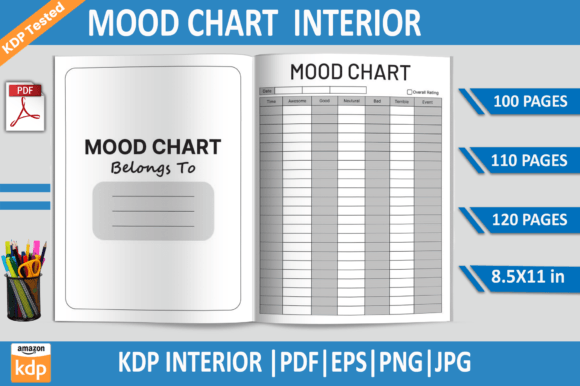
An Amazon KDP seller looking for a niche journal product can use this template as the interior of a low-content or medium-content book. Instead of spending hours formatting pages, they get 100, 110, or 120 pages ready to go. The EPS file allows for small tweaks if they want to add a brand color or a logo, while the PDF version is tested on Amazon and ready to upload. For someone who wants to launch quickly without sacrificing quality, that's a practical advantage.
A team leader or HR professional might explore using mood check-ins as part of a workplace wellness initiative. While privacy is a concern, a voluntary and anonymous mood tracker can help a team notice collective trends. Are Mondays generally harder than Fridays? Does a major project deadline correlate with lower scores across the board? These observations can lead to better scheduling or more support during high-stress periods.
Even a student navigating the ups and downs of academic life can benefit. Exam season, social pressures, and irregular sleep all leave marks on a mood chart. Over a semester, the student sees which study habits are sustainable and which lead to burnout. The chart becomes a personal feedback loop, not a chore.
Practical Considerations Before You Start Using One
Before you jump in, it's worth thinking about how you or your audience will interact with the template day after day. Consistency matters more than detail. Five seconds of honest input each day beats ten minutes of elaborate note-taking once a week. The template's simple layout supports quick entries, but only if you keep it visible and accessible.
For KDP publishers, the file format matters. The template includes PDF files at three different page counts, so you can choose the thickness that fits your target price point and audience expectation. A 100-page journal feels light and approachable. A 120-page version feels more substantial. The EPS file gives you flexibility to edit if you want to add your own cover design or tweak the layout slightly. The PNG and JPG files are useful for previews, mockups, or promotional images on your product listing.
Print quality is another factor. The template is set at 300 DPI with an 8.5x11 inch trim size, which is a standard for Amazon KDP. No bleed options mean less trimming hassle for certain print setups. But always double-check the current KDP guidelines because requirements can shift. The template is described as KDP tested, which saves you from common rejection headaches, but it's still smart to preview the upload in KDP's online tool before hitting publish.
Another consideration is the audience's comfort level with self-reflection. Not everyone is ready to look at their moods honestly. Some people prefer a simpler check-in, like a smiley face scale, while others want a numerical rating or space for notes. This template uses a format that balances detail with simplicity, but you or your customers can always adjust the complexity by adding instructions or prompts on the cover or inside pages.
Strengths and Limitations Worth Noting
Let's start with what works well. The template's strength lies in its structure. It's clean, uncluttered, and professional. The 300 DPI resolution ensures crisp printing whether you use a home printer or a commercial press. The multiple file formats mean you're not locked into one workflow. If you prefer editing in Adobe Illustrator, the EPS file is ready. If you want to print immediately, the PDF is tested and reliable. The inclusion of both PNG and JPG files makes it easy to create digital mockups for marketing without needing to open the editable file.
The variety of page counts is another practical advantage. You can offer the same interior in different sizes or price tiers. A 100-page version might appeal to a budget-conscious buyer, while the 120-page version feels like a more complete annual tracker. That flexibility helps you test what resonates with your audience without creating entirely new products from scratch.
On the limitation side, this template is designed for a specific trim size. If you want to publish a 6x9 or 5x8 journal, you would need to adjust the layout, which requires some comfort with editing the EPS file. The template also assumes a certain level of user commitment. Tracking moods for a full year requires daily attention, and some people lose interest after a few weeks. A built-in instruction page or a brief how-to note could help maintain engagement, but that's something you might need to add yourself.
Another point is that the template uses a straightforward chart format without built-in prompts or emotional vocabulary. For some users, that's perfect. They want a blank canvas. Others might benefit from a list of feeling words or a color-coded legend. If you're publishing for a beginner audience, consider adding a supplemental page with suggestions. The template gives you a solid foundation, but you can always enhance it with a short guide or a sample entry.
Also, the no-bleed option works well for certain print setups, but if you want full-bleed pages with color backgrounds, you'll need to adjust the file. That's not a flaw, just a design choice that fits a clean, minimalist aesthetic.
How the Template Fits Into a Larger Practice
Using a mood chart isn't a standalone solution. It works best when paired with other habits. Someone tracking their mood might also keep a brief gratitude log, a sleep tracker, or a simple habit checklist. The mood chart becomes one layer of a broader self-awareness system. The template's generous page count allows for a full year of tracking. That's enough time to see seasonal patterns, not just weekly ones.
For KDP sellers, this means the product can be positioned as part of a bigger wellness or productivity bundle. You might offer a companion habit tracker or a goal-setting journal. The consistent size and design language make cross-selling natural. Customers who buy a mood chart journal are often the same people looking for meal planners, workout logs, or daily gratitude journals.
For individual users, the template serves as a low-stakes entry point into emotional awareness. You don't need to be a journaling expert or a mental health professional. You just need to check in with yourself for a few seconds each day. Over time, those small data points add up to a picture of your emotional life that feels grounded in reality rather than memory.
Bringing It All Together
A Mood Chart KDP Interior Template is more than a printable grid. It's a practical bridge between daily experience and self-understanding. Whether you're a publisher looking for a tested, ready-to-upload interior for your next Amazon KDP product, or an individual seeking a simple way to track emotional patterns, the format supports both goals with minimal friction. The included file types give you flexibility at every stage, from editing to printing to promotion. And the real-world scenarios where it becomes useful, from parenting to therapy to workplace wellness, show that this isn't just a niche product. It's a tool that adapts to different lives, different needs, and different levels of commitment.
If you're considering using it for publishing, the tested PDF files and multiple page counts reduce the guesswork. If you're using it personally, the clean layout and professional quality make it feel like a serious practice rather than a casual experiment. Either way, the value comes from consistent use, not from the template itself. But having a well-designed, ready-to-use template removes the biggest barrier: the friction of starting from scratch.
Take a look at your current routine. Is there a pattern you're curious about but haven't tracked yet? A mood chart might be the simple tool that turns curiosity into clarity.