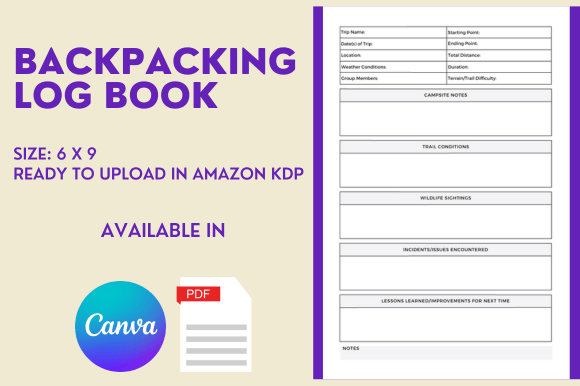
The Backpacking Log Book: More Than an Interior, It's Your Journey Journal
You know that feeling when you return from an incredible trip, and within a few weeks, the small details start to blur? The name of that perfect campsite, the mileage of that grueling uphill stretch, or the exact brand of trail mix that kept you going. Memories are wonderful, but they fade. A written record, on the other hand, becomes a permanent artifact of your adventures. That's exactly where a dedicated Backpacking Log Book - KDP Interior comes into play. It’s not just a notebook; it’s a structured tool designed to capture the raw, unfiltered experience of the trail, whether you are the one hiking it or the one publishing it for others to enjoy.
Beyond the Checklist: Why You Actually Need This Log
If you've ever tried to keep a plain journal on a backpacking trip, you know how quickly it falls apart. Blank pages can feel intimidating, and when you're exhausted at the end of a 20-mile day, you don't want to think about what to write. You just want to dump the data and the feelings. A specialized log book gives you that framework. It is the difference between staring at a white wall and walking into a room with thoughtfully placed hooks for your thoughts.
The Solo Thru-Hiker’s Secret Weapon
Consider the long-distance hiker. For them, a log book is a lifeline. They need to track water sources, resupply strategies, zero days, and the names of fellow hikers they met on the trail. The structured prompts in a Backpacking Log Book - KDP Interior allow for quick, efficient logging. You can note which gear failed, which campsite had the best views, and exactly where you hit the wall mentally. Over the course of a 2,000-mile trail, these notes become invaluable for planning the next big hike or simply reliving the journey. It’s a data-driven approach to nostalgia.
The Family Adventure Scrapbook
Now, imagine a different scenario: a family of four loading up the minivan for a weekend at a state park. Mom wants to document the trip, but she doesn't have time to scrapbook. With this log book, the kids can draw the map of the hike, log the first fish they caught, and rate the campsite. It becomes a collaborative family history. Years later, flipping through those pages will mean more than any Instagram post. It captures the mud on the boots, the taste of the campfire chili, and the sound of the rain on the tent. The 6x9 size is perfect for tucking into a gear bin or a kid's backpack.
From Trail to Spreadsheet: The Gear Nerd’s Best Friend
There's a specific type of backpacker who loves the gear almost as much as the trail. They are constantly testing, swapping, and upgrading their kit. For them, a log book is a testing ground. They aren't just logging miles; they are logging performance. Did the new ultralight tent hold up in wind? How many miles did you get out of those trail runners before the soles wore thin? Which stove boiled water fastest at altitude?
This is where the practical, real-world utility of a structured interior shines. With dedicated sections for notes on gear, you can create a personal database of what works and what doesn't. You can track the weight of your pack, the calories you consumed, and the condition of the trail. This turns your backpacking log into a performance analysis tool, helping you refine your setup for the next adventure. It’s the difference between guessing and knowing.
The Publisher's Goldmine: Why This Niche Interior Works
If you are on the creation side of the low-content business, you already know that success lives in the details. The outdoor niche is massive, but it's also fiercely passionate. Backpackers are planners, list-makers, and data-lovers. They crave structure. The Backpacking Log Book - KDP Interior is designed to feed that craving. It's a targeted product for a specific audience, which makes marketing it infinitely easier. You aren't selling a generic notebook; you are selling a solution to a very specific problem: how to preserve a backcountry experience.
The Canva Advantage: Customization Without the Headache
Here’s where it gets practical for the publisher. The product comes with a PDF file with 110 Pages Ready to upload, plus an editable Canva template link. This is a massive time saver. You don't have to stare at a blinking cursor, wondering how to set up your sections or your margins. The hard work is done. You get a professionally formatted interior with the BLEED setting already configured for the 6 x 9 trim size.
But you aren't locked in. Because it's a Canva template, you can absolutely add your own unique spin. Maybe you want to add a section for local flora and fauna. Maybe you want to change the font to something more rugged. Maybe you want to include a pre-filled gear checklist at the beginning. You can do all of that without starting from scratch. It gives you the freedom to brand the interior, making it your own, while saving valuable time and energy. You can focus your creativity on making the product sell, not on wrestling with formatting.
The Analog Advantage: Disconnecting to Reconnect
In a world saturated with screens, there is a growing hunger for analog experiences. Many backpackers go into the woods specifically to get away from their phones. A physical log book fits this ethos perfectly. It requires no battery, no signal, and no charging cable. It’s just you, a pen, and your thoughts.
The act of handwriting itself changes the experience. When you write by hand, you process the day differently. You slow down. You remember the smell of the pine, the texture of the rock, the kindness of a stranger. A thoughtfully designed interior encourages this mindfulness. It prompts you to reflect, not just report. It turns a simple trip log into a deeply personal journal. The size is also crucial here. At 6 x 9, it slips easily into the outer pocket of a backpack or a dry bag, ready to be pulled out at the end of a long day without adding significant weight or bulk.
Strengths and Practical Considerations
No product is perfect for every situation, and understanding the strengths and limitations of this interior helps you use it effectively.
What Makes This Interior Stand Out
- Time Efficiency: The biggest win is the head start. 110 pages of structured, ready-to-upload content means you can have a product live on the shelf in a fraction of the time it takes to build from scratch.
- Targeted Design: It’s built for a specific audience. The prompts and structure are relevant to backpackers, which increases the perceived value and reduces returns. It feels custom-made because it essentially is.
- Flexibility: The editable Canva template link is a game changer for publishers who want to customize. You can adjust the tone, add your logo, or tweak the layout to fit a sub-niche (like ultralight backpacking or family camping).
- Professional Formatting: The 6 x 9 size with BLEED setting is a standard, professional format that looks great on the shelf and prints well through KDP.
What to Keep in Mind Before You Publish
- You Need a Cover: This is the interior only. The success of your KDP product depends heavily on a compelling, relevant cover that speaks to the backpacking audience. Don't rush the cover design.
- Understand Your Market: This interior is a tool. It works best when you have a clear picture of who you are selling to. Are you targeting PCT thru-hikers or weekend car campers? The prompts can be customized in Canva to better fit your specific audience.
- Canva Proficiency Helps: While the no-fuss, no-mess design is simple, you'll get the most out of it if you are comfortable with Canva's basic tools. Adding your own touch is what will differentiate your book from the competition. It's a head start, not a finish line.
- Niche Saturation: The backpacking niche is popular. Your marketing strategy—keywords, description, and cover—will determine your success. The interior gives you a quality foundation, but you need to build the house.
Making the Most of Your Blank Slate
Think of this 110-page PDF as a canvas. It is structured but not rigid. You can use the Canva template to add specific sections that matter to you or your target audience. Consider adding a page for tracking wildlife sightings, a dedicated spot for rating campsite amenities, or a blank page for sketching topographical features. The prompts are a guide, not a cage. The best users of this interior treat it as a starting point for building a brand—whether that brand is their own personal adventure archive or a line of profitable outdoor journals for the KDP marketplace.
Ultimately, whether you are lacing up your boots to hit the Pacific Crest Trail or sitting down at your laptop to build your next low-content bestseller, the Backpacking Log Book - KDP Interior offers a practical, flexible, and deeply useful framework. It respects your time, values your experience, and gives you the structure you need to capture the journey—one mile, one entry, one adventure at a time.