Sudoku Puzzle Easy to Hard for Kids: A Practical Resource for Publishers and Educators
Creating content that engages young minds while supporting cognitive development is a challenge that many publishers, educators, and content creators face regularly. Puzzle books remain a reliable category in both educational and commercial publishing, but the market demands resources that balance accessibility with genuine developmental value. Sudoku Puzzle Easy to Hard for Kids enters this space as a ready-to-publish collection designed to serve both the practical needs of content producers and the developmental needs of children.
This article evaluates the resource from a professional standpoint, examining its structure, usability, and potential fit for various publishing and educational projects. Whether you are preparing a title for Amazon KDP, assembling classroom materials, or searching for a flexible asset that can be adapted across formats, understanding what this collection offers—and what it does not—will help you determine whether it aligns with your objectives.
What the Resource Provides
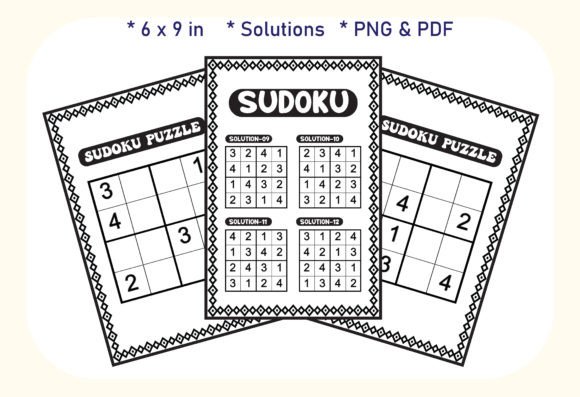
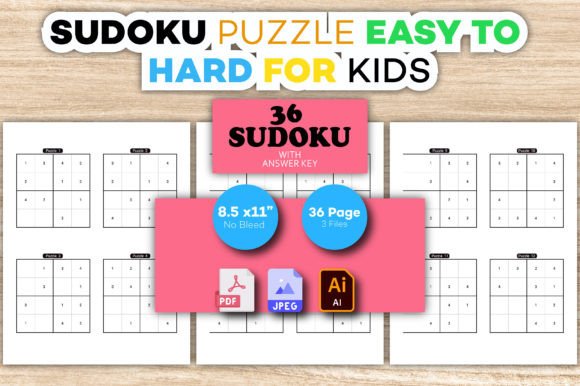
At its core, Sudoku Puzzle Easy to Hard for Kids is a complete puzzle collection packaged for direct upload to Amazon KDP. It includes 100 puzzles that progress systematically from easy to challenging levels, specifically tailored for children. The product dimensions are set at 8.5 x 11 inches with no bleed, which is a standard and practical choice for print-on-demand publishing. High-resolution interiors at 300 dpi ensure that the puzzles reproduce cleanly in both digital and print formats.
The file package is notably comprehensive. Users receive one PDF file, one EPS file, one AI file, 36 JPEG files, and 36 transparency PNG files. This variety matters because it supports different workflows. The PDF serves as a complete, ready-to-upload book interior. The EPS and AI files allow for layout adjustments, resizing, or customization in vector editing software. The JPEG and PNG files provide individual puzzle pages that can be used for previews, marketing materials, or integration into other digital products.
Key Characteristics and Purpose
The primary purpose of Sudoku Puzzle Easy to Hard for Kids is to reduce the production burden for publishers and content creators while delivering a product that meets market expectations for children's puzzle books. The gradual difficulty progression is intentional: children can begin with simpler puzzles that build confidence and pattern recognition before moving to more complex grids that require greater logical reasoning.
Several characteristics stand out:
- Graded difficulty system: The puzzles are not randomly mixed but arranged in a sequence that respects a child's learning curve. This makes the resource suitable for both recreational use and structured cognitive development activities.
- Standard trim size: The 8.5 x 11 inch format is widely accepted on KDP and compatible with most retail printing systems. No bleed simplifies the upload process and reduces the risk of trimming errors.
- Multiple file formats: Rather than locking users into a single file type, the package provides flexibility. This is particularly valuable for creators who need to adapt puzzles for different platforms or who prefer working in specific software environments.
- High-resolution output: The 300 dpi specification ensures that puzzles appear crisp on paper and on screen. This is non-negotiable for professional publishing and also benefits digital distribution where image clarity matters.
Strengths from a Practical Perspective
Evaluating a resource like this requires looking beyond the puzzle content itself and considering how it functions within a real-world production workflow. Several strengths emerge from this angle.
Time savings are substantial. Creating 100 original puzzles from scratch, testing them for solvability and appropriate difficulty, formatting them for print, and preparing files for multiple output formats would take many hours. Sudoku Puzzle Easy to Hard for Kids compresses that effort into a single acquisition. For a freelancer or small publisher juggling multiple projects, this efficiency is meaningful.
File format diversity reduces technical friction. The inclusion of EPS and AI files means that users who want to modify puzzle layouts, adjust font sizes, add branding elements, or change color schemes can do so without needing to manually rebuild puzzle grids. The JPEG and PNG files serve immediate needs for mockups, promotional graphics, or inclusion in digital bundles. The PDF acts as a ready-to-upload file that requires minimal additional processing.
Difficulty progression supports multiple age groups. While the puzzles are designed for children, the range from easy to hard allows the same book to serve children of different ages or skill levels. A seven-year-old may work through the early puzzles, while an older child or a more experienced puzzle solver can tackle the later ones. This extends the product's useful lifespan beyond a single developmental stage.
Who Benefits Most from This Resource
Based on the file package and intended use, several groups are likely to find Sudoku Puzzle Easy to Hard for Kids particularly well suited to their needs.
Self-Publishers and KDP Authors
Publishing on Amazon KDP requires content that is original, properly formatted, and marketable. For authors who want to enter the puzzle book category but lack the design skills or time to create puzzles from scratch, this resource provides a complete interior file that can be paired with a cover and uploaded directly. The no-bleed, 8.5 x 11 format aligns with KDP specifications, reducing the chance of upload errors or rejection.
Educators and Homeschool Parents
Teachers and parents who use puzzles as supplementary learning tools will appreciate the graded difficulty structure. Sudoku puzzles support skills such as logical reasoning, attention to detail, pattern recognition, and sustained concentration. Having 100 puzzles in a single resource means that an educator can select puzzles appropriate for individual students without needing to compile materials from multiple sources.
Content Creators and Digital Product Sellers
The inclusion of JPEG and PNG files makes this resource attractive for creators who sell digital products on platforms like Etsy, Teachers Pay Teachers, or Gumroad. Individual puzzle pages can be offered as standalone downloads, combined into smaller packets, or used as lead magnets. The transparency PNG files allow for integration into other designs or worksheets.
Publishers Seeking Asset Libraries
Small publishing houses or educational content developers who need a reliable puzzle library for multiple projects will benefit from the vector file formats. AI and EPS files can be repurposed across different book layouts, repackaged for series, or adapted for different age groups by scaling or modifying the grid designs.
Realistic Assessment of Quality and Usability
From a design and production standpoint, the resource meets the technical requirements for commercial publishing. The 300 dpi resolution ensures that printed puzzles will be sharp, which is important for children who are still developing fine motor control and need clear grid lines to write in. The no-bleed specification simplifies trimming, though it does mean that puzzle pages will have white margins rather than extending edge-to-edge color or design elements. For a puzzle book, this is standard and generally acceptable.
One consideration is that the resource provides the puzzle content and formatting but does not include instructional material or answer keys. Depending on your audience, you may want to add a brief introduction explaining how to solve sudoku puzzles, especially for younger children who may be encountering the format for the first time. Similarly, answer keys are not included in the listed files, so you would need to generate them separately if you want to include solutions in the back of the book. This is a common omission that many publishers handle on their own, but it is worth factoring into your production timeline.
The difficulty progression is a genuine strength, but the absence of clear labeling within the resource could be a minor limitation. If you are publishing for a broad age range, you may want to add section headings such as "Easy Puzzles," "Medium Puzzles," and "Hard Puzzles" to help users navigate. Since the AI and EPS files are included, this customization is straightforward.
Long-Term Value and Flexibility
Resources that serve a single purpose often lose value once that purpose is fulfilled. Sudoku Puzzle Easy to Hard for Kids offers longer-term utility because of the multiple file formats and the evergreen nature of puzzle content. Sudoku puzzles do not become outdated, and the same puzzle can be used in different contexts—printed in a book, included in a digital activity pack, featured on a blog, or distributed as a classroom handout.
The vector file formats allow you to modify the puzzles for different audiences. For example, you could enlarge the grids for younger children who need larger writing spaces, or reduce the grid size for a compact travel edition. You could also add thematic branding, integrate puzzles into a larger workbook, or combine them with other activity types. This adaptability extends the resource's usefulness beyond a single publication.
Practical Recommendations for Use
If you decide to work with Sudoku Puzzle Easy to Hard for Kids, a few practical steps will help you get the most value from the package.
- Review and test a sample of puzzles. Before uploading the complete file, print a few puzzles from the easy, medium, and hard sections to verify that the difficulty levels are appropriate for your target audience. While the progression is built into the resource, individual perceptions of difficulty vary.
- Consider adding a how-to page. Many children will benefit from a simple explanation of sudoku rules. A single page with a small example puzzle and step-by-step instructions can significantly improve the user experience.
- Generate answer keys early. If you plan to include solutions, create them during your setup phase rather than waiting until the file is otherwise complete. This ensures consistency and avoids last-minute errors.
- Leverage the PNG and JPEG files for marketing. Use several puzzle pages as preview images for your KDP listing, social media posts, or email promotions. Showing actual interior content builds trust with potential buyers.
- Customize the book interior in the vector files. Even small changes, such as adding a footer with page numbers or including a branded header, can make the published book feel more polished and unique.
Limitations to Consider
No resource is universally perfect, and being transparent about limitations helps you make an informed decision. The lack of answer keys means additional work if you want to include solutions. The absence of instructional content means you will need to supply that separately unless your audience already knows how to play. And while the 100-puzzle count is substantial for a single book, some publishers may want a larger collection for a series or a thicker volume. Assessing these factors against your specific project requirements will determine whether this resource is a good fit or merely a starting point.
For most independent publishers, educators, and content creators, the benefits of ready-to-use puzzle content with multiple file formats outweigh the need for minor customization. The resource delivers what it promises: a complete, professionally formatted puzzle collection that can be published, adapted, and distributed with relative ease.
Ultimately, Sudoku Puzzle Easy to Hard for Kids serves as a practical tool for anyone who needs quality puzzle content without the overhead of creating it from scratch. Its value lies not only in the puzzles themselves but in the flexibility it provides across different publishing and educational contexts. When evaluated against the demands of real-world production timelines and audience expectations, it stands as a resource worth considering for your next puzzle book project.